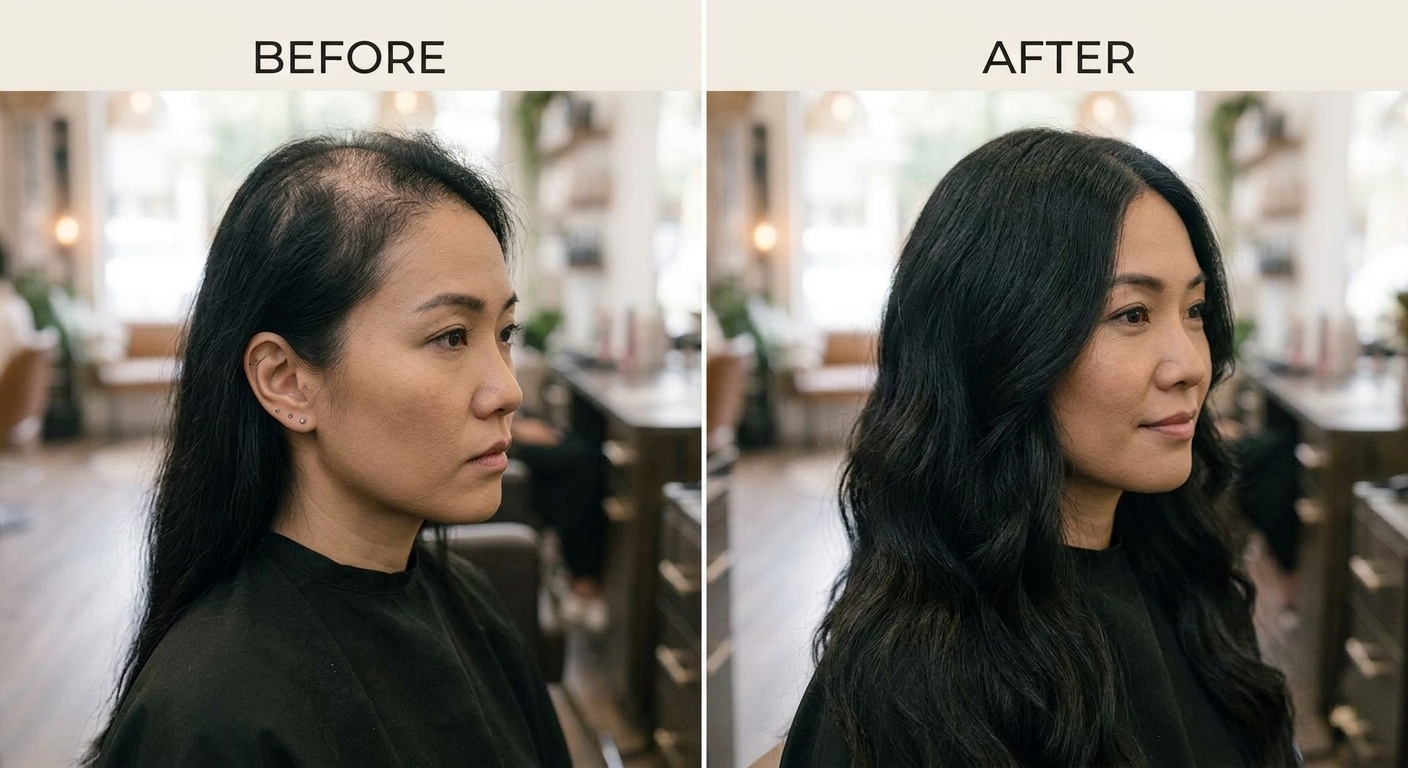
Thinning hair affects many people,and finding a discreet way to add density can make a real difference to confidence.Mesh integration is one of the methods hair specialists use for this.This guide explains what it is,how it differs from other options,who it may suit,and what clients and stylists should understand before starting.Technique details differ between trainers and systems,so this describes the general principle,and your own training provider’s method should always take priority.
What is mesh integration?
Mesh integration is a technique in which a fine mesh base is attached to the client’s own hair,and extension hair is attached to the mesh.The client’s hair stays in place and the added hair blends with it,which builds density and coverage in areas where the hair has thinned.The mesh is shaped and positioned to suit the client’s pattern of thinning,then the hair is cut and blended so the result looks like her own.
It is a cosmetic service.It adds hair and coverage,but it does not treat the cause of hair loss and does not make the client’s own hair grow.
How it differs from other options
| Option | How it works | Typical consideration |
|---|---|---|
| Mesh integration | Mesh fixed to the client’s own hair,with hair added to the mesh | Needs enough of the client’s own hair to anchor to,and regular maintenance |
| Strand extensions(rings,tape,bonds) | Individual strands or wefts attached to the client’s hair | Adds length or volume,but may add weight to fine,thinning hair |
| Hair toppers | A piece that clips or attaches over an area,usually removed daily | Can be removed,but is a separate piece the client puts on and takes off |
| Wigs | A full head covering | Covers the whole head,no anchor to own hair needed |
Each has its place,and the right choice depends on the client’s hair,her scalp,her lifestyle and what she wants.
How a mesh integration service usually runs
- Consultation.The specialist looks at the hair and scalp,discusses where the client wants more density,and explains what the method can and cannot do.
- Planning.The thinning area is assessed.The mesh,hair type,length and colour are chosen to match the client’s own hair.
- Preparation.The mesh is shaped to the area,and the client’s hair is prepared and sectioned.
- Fitting.The mesh is secured to the client’s hair,and extension hair is attached to the mesh in the planned areas.
- Cutting and blending.The new hair is cut and styled to blend with the client’s own.
- Aftercare.The client is shown how to wash,brush and care for the integration,and booked in for maintenance.
Technical points that decide the result
- Enough anchor hair.The mesh needs sufficient healthy hair to attach to securely.Where there is very little hair,or where it is very fragile,the method may not be suitable.
- Weight and tension.Adding hair adds weight,and sustained tension on thin or fragile hair can cause damage over time.Placement and the amount of hair added need careful judgement.
- Mesh shaping and placement.The mesh should follow the area of thinning,sit comfortably against the scalp,and stay hidden under the client’s own hair.
- Colour and texture matching.The added hair has to match the client’s hair in shade,undertone and texture,or the join will show.
- Blending.Cutting the new hair into the client’s own hair is what makes the result look natural.
- Maintenance.As the client’s hair grows,the integration moves away from the scalp and needs adjusting,so regular maintenance appointments matter.
What clients like about it
- Her own hair stays in place,with extra density added
- The result can look natural when it is blended well
- It can be a non-surgical option for people who want to add density
- It does not involve shaving or cutting off her own hair
Things to know before you start
- It adds hair and coverage,but it does not treat hair loss or restore hair growth.
- Regular maintenance appointments are needed as the client’s hair grows.
- It takes skill and time,so the quality of the specialist matters.
- It is not suitable for every client or every kind of hair loss,and some clients will be better served by a different option.
- Some clients will need time to adjust to how it feels at first.
Why a medical check matters
Hair thinning can have many causes,including hormonal changes,medical conditions,nutritional factors,medication,stress and scalp conditions.A responsible specialist encourages clients who have sudden,rapid or unexplained hair loss,patchy loss,or scalp symptoms such as pain,redness or scaling,to speak to their GP or a doctor before starting any hair service.Mesh integration is a cosmetic service and does not replace medical advice.
Common client questions
Will it stop my hair from thinning?No.It adds coverage and density,but it does not treat the cause of thinning.
Will it damage my own hair?Any method that adds weight and anchors to your own hair carries some risk,especially if the hair is fragile.Good technique,suitable hair and regular maintenance reduce the risk,and your specialist should check your hair at every visit.
Can I wash and style it?Usually yes,with care.Your specialist will explain how.
How often will I need maintenance?It depends on how quickly your hair grows and the method used,and your specialist will give you a schedule.
If you are a stylist
Mesh integration can be a valuable speciality for stylists who want to help clients with thinning hair and who are happy to take time over consultation and aftercare.It is more specialised than a standard extension fitting,and clients are often sensitive about hair loss,so good training in both technique and communication matters.From a business point of view:
- Appointments are long and the hair and mesh are a significant cost,so price carefully.
- Clients often need privacy and reassurance,so think about how you set up your space.
- Be careful with claims.Describe the service as a cosmetic way to add density and coverage,and do not suggest it treats or cures hair loss.
- Keep clear records and refer clients to a doctor where appropriate.
See ourmesh integration courseto find out what is included.