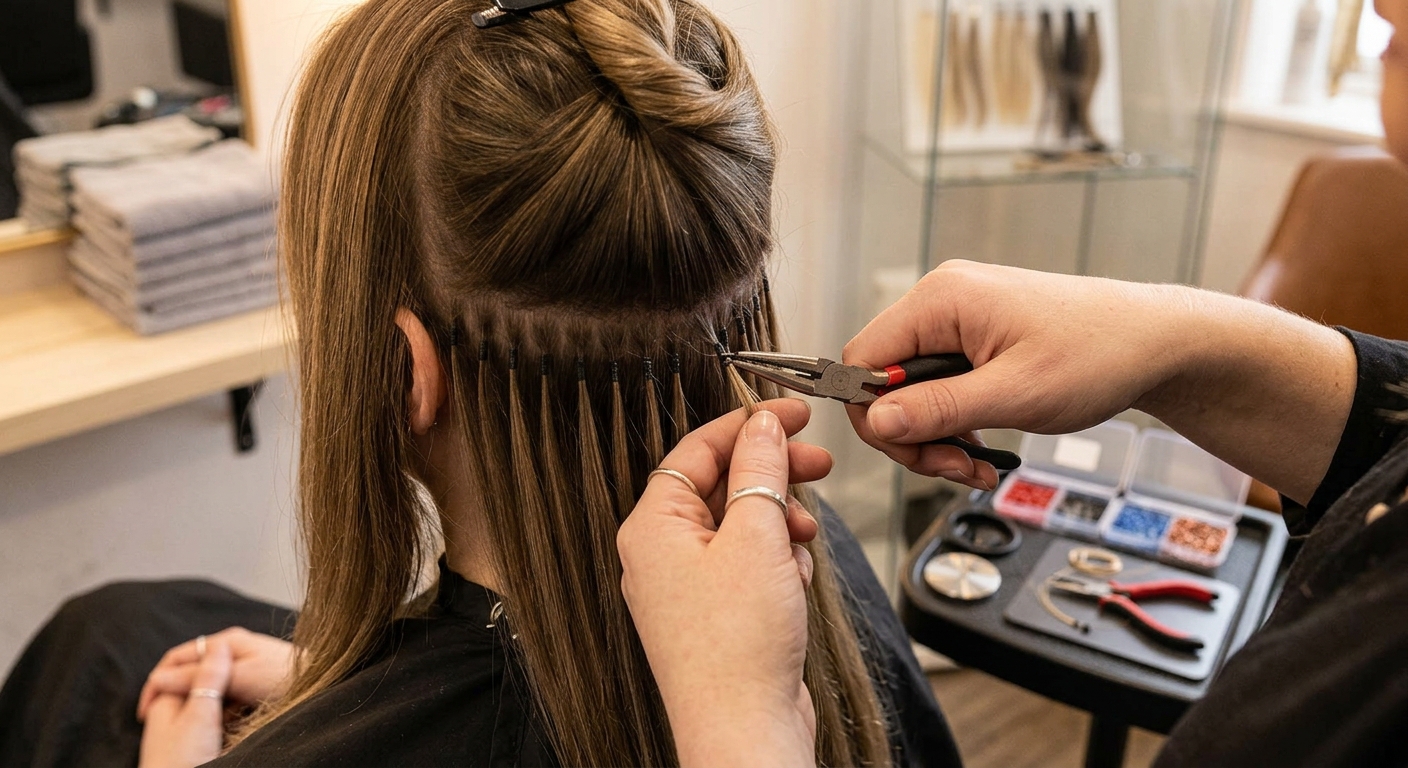
Hair extensions are one of the few services that can change a client’s appearance in a single appointment and then bring her back every few weeks for months.For a hairdresser,mobile stylist or salon owner,that combination of visible results and predictable repeat visits is why so many are adding extensions to their menu.This guide looks at the business case,the technical skills involved,and the professional responsibilities that come with the service,so you can decide whether it is right for you.
Why clients are asking for extensions
Most stylists have been asked about extensions at some point.The reasons vary:length for a special event,volume for fine hair,colour without chemical processing,or a way to blend a grown-out cut.If you cannot offer them,the client often books with someone who can,and may move her colour and cutting appointments at the same time.Offering extensions lets you keep the whole relationship instead of passing part of it to a competitor.
Social media has also changed expectations.Clients see before-and-after transformations online,so they arrive with specific ideas about length,density and colour.That makes a proper consultation more important,because you need to explain what is realistic for their hair type and budget.
The kinds of client you can help
Extensions are not only about length.Common reasons clients book include:
- Adding density to fine hair that struggles to hold volume
- Adding length for a special event or a lasting change
- Adding colour or lowlights without applying colour to their own hair
- Blending in a grown-out cut or shorter regrowth
- Supporting a client who is growing her hair after a big chop
- Adding fullness to areas that have thinned,where the client wants a cosmetic option
That range means you are not limited to one type of customer,and a single skill set serves several different needs.
Understanding the economics
Extension services are more skilled and longer than a standard blow dry,so they are priced higher.But a higher ticket price does not automatically mean a higher profit,so it helps to cost each service properly.
A simple way to price is to add up the following and then add your margin:
- The hair.This is usually your largest direct cost,and quality varies widely,so use a supplier you trust.
- Consumables and tools.Rings,beads,tape,remover,tools and aftercare items.
- Your time.Include the consultation,the fitting itself,blending and cutting,and the aftercare conversation,then multiply by the hourly rate you need to earn.
- Overheads.A share of rent or chair hire,insurance,travel,software,and the time you spend on admin and marketing.
As an illustration only,if a fitting takes four hours and you want to earn a set hourly rate,that rate multiplied by four is already a substantial part of the price before the hair is added.This is an example of the method,not a price guide,because rates vary by area and experience.Check what established technicians in your area charge,and make sure your price covers your own costs before you compare.
It is also worth separating the hair from the labour on the quote.Clients can then see what they are paying for,and you are protected if hair costs change.
Maintenance and repeat bookings
Unlike a one-off treatment,most extension methods need maintenance.Depending on the method,clients return for move-ups,tightening,re-fitting or removal at regular intervals as their own hair grows.That creates a pattern of future bookings you can plan around,which is valuable in a business where quiet weeks are a risk.
To make the most of this:
- Rebook the next appointment before the client leaves
- Send a reminder a few days beforehand
- Price maintenance separately from the first fitting
- Keep regular slots in your diary for maintenance clients
Some technicians also offer a maintenance plan that bundles regular visits into a set monthly fee.That can help clients budget and gives you predictable income,though you should write down exactly what is included and what happens if a client misses an appointment.
Choosing a method to specialise in
There is no single best method.Nano rings and micro rings attach strands with small rings and use no glue or heat.Tape-in extensions use adhesive wefts and are quicker to fit.Wefts,keratin bonds and clip-ins each suit different clients and different working styles.
For most stylists,the practical approach is to learn one method well,build a portfolio and a base of regular clients,and then add a second method.A speciality also makes you easier to find and recommend.A stylist known for natural-looking nano ring extensions on fine hair is easier to refer than one who offers everything.For a full comparison,see our guide to hair extension systems.
Technical foundations before you fit
Good extension work depends on assessment and technique,not only on the fitting itself.
Hair and scalp assessment.Before agreeing to fit,check the client’s hair density,strength,length and condition,and the health of her scalp.Hair that is very fine,fragile or damaged may not support extensions without risk.Scalp irritation or unexplained hair loss should be referred to a doctor before any service.
Tension and weight.Extensions add weight,and sustained tension on the root can lead to traction-related hair loss.Placement,spacing,the amount of hair per attachment and the distance from the root all affect comfort and long-term hair health.This is one of the main reasons proper training matters.
Hair quality.Extension hair varies in source,processing and how well the cuticles are aligned.Poor quality hair can tangle,shed and fade quickly,which reflects on you even when your fitting is excellent.Learn to judge quality,and buy from a supplier who can tell you where the hair comes from and how it is treated.
Colour matching and blending.Matching shade,undertone and texture,and cutting the extensions into the client’s own hair,decides whether the result looks natural.
Removal and aftercare.Safe removal and clear aftercare advice protect the client’s hair and your reputation,and they are part of the service,not an extra.
Professional and legal basics in the UK
Before you offer extensions,check the basics.This is general information,not legal advice,so confirm the details for your own situation.
- Insurance.Make sure your public liability and treatment cover includes extension services,and ask your insurer what proof of training they require.
- Consumer law.Services must be carried out with reasonable care and skill,so keep clear records of what you agreed and did.
- Terms and deposits.A short written agreement covering price,deposits,cancellations,what is included and aftercare avoids disputes.
- Client records and photos.Keep consultation notes securely,and get written consent before sharing a client’s photos or videos.Client information is personal data,so handle it in line with UK data protection rules.
- Tax and registration.If you are self-employed,make sure you are registered with HMRC and keeping accurate records of income and costs.
What can go wrong
It helps to know the risks as well as the benefits:
- Poor training can damage clients’hair and your reputation
- Cheap or poor-quality hair leads to complaints
- Long appointments mean fewer clients per day,so each service needs to be priced properly
- Clients who ignore aftercare advice can have poor results that reflect on you,so explain it clearly and give it in writing
- In some areas competition is high,so a speciality and good reviews matter
Is it right for you?
Extensions suit stylists who enjoy detailed work,like seeing a visible transformation,and want regular clients they know well.They suit you less if you prefer short appointments,because a full fitting takes time and concentration.
If you are considering it,the next step is choosing a method and a training provider that covers consultation,application,removal,aftercare and the business side.Ourhair extension training coursescover the main systems,includingnano ring extensions,so you can start with confidence.